

Prevention Is the Most Effective Treatment
A comprehensive eye exam is an important piece of your overall preventative healthcare plan. Your optometrist screens for common eye conditions during your appointment, such as glaucoma, AMD, cataracts, and diabetic eye disease.
Many eye diseases can progress without noticeable symptoms and cause permanent damage to your vision if left untreated. This makes routine eye examinations crucial for the early detection of eye diseases to prevent vision loss.
We recommend adults 20–64 have an eye exam at least every 2 years, and adults over 65 or living with systemic health conditions, such as diabetes, book exams more often. Be proactive about your eye health and book your comprehensive eye exam with us today.
Why Is Early Detection Important?
Many eye diseases begin without noticeable symptoms. Routine comprehensive eye exams assess your vision and eye health to screen for early signs of disease.
If detected early, eye diseases have better treatment and management outcomes, helping us to maintain your vision and protect your long-term ocular health.
Common Eye Diseases We Monitor and Manage
We use our eye care technology in conjunction with comprehensive evaluations to determine your risk for various eye conditions. By taking into account your lifestyle, personal health history, and family history, we can assess how high your risk of these conditions may be.
After detection, certain serious eye conditions, such as glaucoma, macular degeneration, keratoconus, and diabetic eye disease, require consistent monitoring. While these conditions can be managed, they are not curable. Other conditions, like conjunctivitis, can typically be treated following a thorough evaluation and diagnosis.
AMD is a progressive eye disease that affects the macula, an area of the retina responsible for your central vision and most of your colour vision. AMD is the leading cause of vision loss in adults over age 55. It can be hereditary, and has also been associated with lifestyle factors like smoking, excessive UV exposure, and poor diet.
We monitor for AMD through retinal imaging and optical coherence tomography (OCT) scans, as well as vision assessments.
A cataract occurs when the normally clear lens of the eye becomes cloudy and more difficult to see through. Usually associated with age, cataracts can develop earlier due to lifestyle factors such as poor diet or excessive UV exposure, and from systemic health conditions like diabetes, heart disease, and certain genetic disorders.
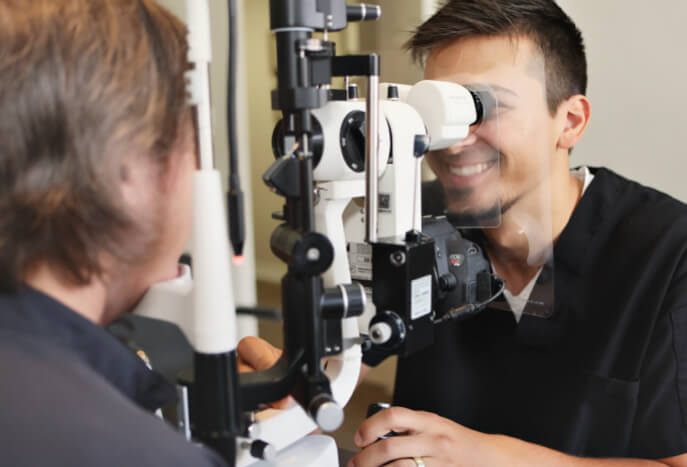
Your optometrist will monitor for cataracts through routine eye exams using a slit lamp microscope. Cataracts can be managed with updated spectacle lens prescriptions, and referral for cataract surgery, as needed.
Dry eye disease, also known as ocular surface disease, is caused by an imbalance in the tear film, leading to uncomfortable symptoms. Dry eye can occur due to a lack of sufficient tear production or because the tears produced lack the proper composition.
We monitor for dry eye through reported symptoms, meibography, and measuring your tear breakup time to check how well your tear glands are functioning.
Conjunctivitis, commonly known as pink eye, is the inflammation of the thin, transparent layer that covers the front of your eye and inside of your eyelids, called the conjunctiva.
Conjunctivitis can be caused by infections, allergies, or chemical exposure. Optometrists are highly qualified in diagnosing and treating conjunctivitis, and other infections of the eye.
Glaucoma is a common eye disease, and refers to a group of eye diseases characterized by damage to the optic nerve, the part of the eyes that sends visual information from the eye to the brain. There are several types of glaucoma, all of which result in a gradual loss of your peripheral vision, and if left untreated, eventual blindness.
There are many risk factors for glaucoma, including age, family history, gender, eye colour, and certain medical conditions.
We monitor for glaucoma through eye pressure checks, visual field testing, and OCT scans.
Diabetic eye disease refers to a group of complications in the eye resulting from uncontrolled diabetes. Prolonged periods of elevated blood pressure, or spikes in blood sugar, can cause damage to the tiny blood vessels at the back of the eyes, which can lead to permanently impaired vision.
We monitor for diabetic eye disease through annual comprehensive exams, including retinal imaging, OCT scans, eye pressure checks, and visual assessments.
Keratoconus is a progressive disease that affects the cornea. Keratoconus causes the normally dome-like cornea to thin and bulge outwards, distorting vision. Keratoconus can be managed with prescription glasses or contact lenses, or through a procedure called corneal cross-linking (CXL), performed by an eye surgeon.
We screen for keratoconus during routine eye exams through a number of tests, including corneal topography and refraction.
Floaters are small, semi-transparent spots that appear to “float” around in the vision. In most cases, floaters are harmless, and most people experience them from time to time.
However, if you notice a significant increase in floaters or if they are accompanied by flashes of light, it could indicate a more serious condition. If you notice significant or sudden changes to your vision, call us to book an appointment immediately.
Our Technology to Monitor Eye Health
At Orangeville Optometric Centre, we believe that technology is essential in delivering the highest standard of eye care. We are passionate about investing in diagnostic tools that allow us to see more, detect earlier, and care better.
By embracing innovation, we position ourselves to proactively address eye diseases rather than merely react to them. Technology empowers us to be more confident in our clinical decisions and be able to personalize each visit to every individual.
Learn more about the different diagnostic tools we use and what these devices assess:
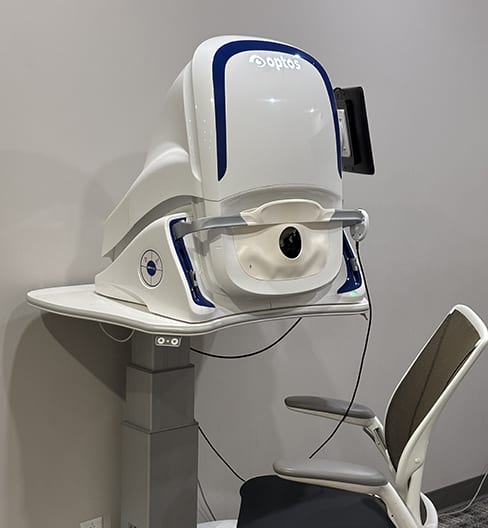
We use the Optos MonacoPro SD-OCT device for retinal imaging and optical coherence tomography (OCT) scans. This innovative device captures an image of the inside of your eye, including the retina, vitreous body, and optic nerve head.
The MonacoPro uses the Optomap technology to capture a high-contrast, ultra-widefield view, allowing us to see up to 80% of your retina in a single image. The integrated OCT scan maps the layers of your eye using light waves to create a cross-sectional image of your retina and optic nerve.
The MonacoPro helps us to monitor your eyes for signs of glaucoma, AMD, diabetic eye disease, and other retinal conditions.
Pachymetry is a measurement of the thickness of your cornea, the clear part of your eye that covers your iris and pupil.
Corneal pachymetry is an important test to screen for glaucoma, as well as to determine if you are a candidate for laser eye surgery.
Meibography captures images of the meibomian glands, the tiny, oil-producing glands that line the eyelids and play a critical role in maintaining a healthy and balanced tear film.
Meibomian gland dysfunction, a common cause of dry eye, can be identified through meibography.
Your visual field refers to the entire area your eyes can see in all directions without moving from a fixed point. In other words, your visual field includes both your peripheral and central vision.
We use the Zeiss Humphery Visual Field Analyzer to test your visual field and track it over time. It allows us to detect changes to your vision that could indicate conditions such as glaucoma.
Testing your visual field is also an important assessment to prove that you meet the vision standards necessary to drive in Ontario. We provide visual field tests for the Ministry of Transportation (MTO).
Tonometry is a measurement of your intraocular pressure (IOP), or the amount of pressure inside your eye. We use an applanation tonometer to perform this test.
Applanation tonometry uses a flat-tipped probe to gently touch the cornea.
Corneal topography maps the front surface of your eye. This is an important test for individuals diagnosed with or suspected to have keratoconus, in order to measure and track changes to the shape of the cornea. It’s also used to precisely measure your eyes for contact lenses.
Book Your Comprehensive Eye Exam Today
Routine, comprehensive eye exams are the first and most crucial step in defending against eye diseases. These screenings allow us to catch conditions in their early stages, which is key to preventing vision loss and maintaining excellent ocular health.
Whether you’re taking proactive steps for your eye health or managing a diagnosed condition, the Orangeville Optometric Centre is here to guide you through your care. Schedule your comprehensive eye exam with us today.
CAN YOUR GLASSES DO THIS?
For individuals ready to step into the future, we carry Ray-Ban and Oakley Meta AI glasses. Listen to music, take a phone call, or capture a video, all from your glasses.
Or enhance your connections with Nuance Audio Glasses for directional hearing amplification.


OUR FEATURED EYEWEAR BRANDS
Visit Our Location
We’re located on First Street, just across from the Lord Dufferin Centre. Parking is available behind the building with an accessible parking stall beside the entrance to the lot.
Our clinic has an accessible exam lane to accommodate individuals with wheelchairs or other mobility aids.
Our Address
Contact Information
- Phone: 519-941-6761
- Email: info@orangevilleoptometrists.ca
Our Hours
*Open on alternating Saturdays. Book an appointment in advance.
Our Google Reviews
What Patients are Saying
Amazing Doctors. Friendly and knowledgable staff. Makes the whole experience a pleasure. Highly recommended.
– Maureen
Prompt diagnosis of uveitis. Saved my vision. Forever greatful, thank you Dr. Costanzo
– G B
I have been seeing Dr Leblanc for years and now bring my son to see him as well. He is such a pleasure to deal with and although we only see him yearly, he remembers what’s going on in our lives and asks questions. He’s the best!
The reception staff are great as well!
– Trina
I’ve been going here for years. The staff are extremely helpful and very friendly. I especially find they answer all my questions and any concerns that I may have regarding eye care or even the right lenses to choose from. It’s always a pleasure to go there whether replacing my out dated frames or purchasing new frames and lenses for my eye care. They always inform me of specials too so I can add an additional option if desired.
– Kim
We drove from London for our appointment because they had my fiancé’s files. It was very worth the drive there. They were thorough, professional and friendly. We are very happy with our visit and look forward to returning soon to pick up the four new pairs of glasses!
Thank you to all the staff, Dmytro and Marlene
– June